Conversion · Guide
Gift with purchase vs one more 10% off
A gift with purchase costs a fixed unit while an extra 10% off scales with the basket. The arithmetic, the threshold, and where the discount wins.
By Sonam Patel, CEO & Co-Founder9 min read
A gift with purchase and an extra 10% off look like the same reward to a shopper. One is a thing, the other is a number, and the thing usually feels bigger. They are not priced anything like the same way, and that gap is where most of the margin in a promotion actually lives.
Here is the arithmetic of choosing between them, and the four situations where the cheaper option is the wrong one.
Why the two are not priced the same way
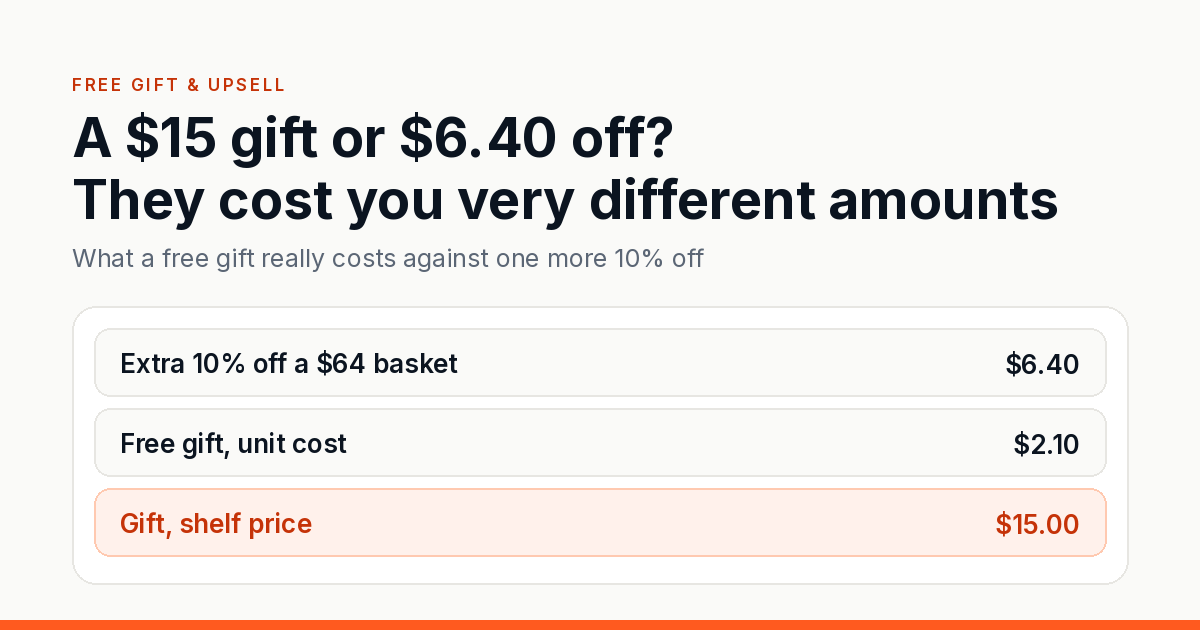
A percentage discount is a transfer of margin. Give another 10% off a $64 basket and you have given away $6.40, on every order that takes it, with nothing coming back except the hope of conversion.
A gift is a transfer of inventory. Give away a mug that costs you $2.10 to make or buy and the shopper receives something with a $15 shelf price while you part with $2.10 plus whatever the extra weight does to the freight.
That asymmetry is the whole argument. A discount costs a share of the sale. A gift costs a fixed amount regardless of the sale, so the mathematics favour the gift more the larger the basket gets.
| Basket | Extra 10% costs | Gift costs |
|---|---|---|
| $40 | $4.00 | $2.10 |
| $64 | $6.40 | $2.10 |
| $120 | $12.00 | $2.10 |
| $250 | $25.00 | $2.10 |
On the small basket the gap is modest. On the large one it is the difference between a promotion and a write-off.
The arithmetic, worked on a real month
Take a store doing 1,000 orders a month at a $64 average order, with a gift whose unit cost is $2.10 and a shelf price of $15.
Option A: another 10% off orders above $60.
Assume 60% of orders clear the bar and take it. That is 600 orders times $6.40, so $3,840 of discount in the month.
Option B: a free gift at $70.
Assume 55% of orders reach $70, which is a bigger ask than $60 and therefore a lower take rate. That is 550 gifts at $2.10, so $1,155. Then add freight: if 180 grams of ceramic pushes 40% of those parcels into the next carrier band at $1.90, that is another $418. Total $1,573.
The gift costs less than half what the discount costs, and the shopper perceives it as worth $15 rather than $6.40. That is before counting the orders that only reached $70 because the gift was there, which is the part you cannot see in the first month.
Where the gift wins, and why
The shopper who was going to buy anyway. A discount pays out to everyone, including the customer who had already decided. A gift at a threshold pays out only to the shopper who added something to get there.
The catalogue with a hero product. If your bestseller sells at full price and rarely goes on sale, discounting it teaches the market to wait. A gift attached to it protects the price while still giving the shopper a reason to act now.
The brand with a signature. A discount is generic. Anyone can offer 10%. A gift can carry the brand, whether that is a sample of the next range, a piece of packaging worth keeping, or a small accessory that only your store has.
The margin that is already thin. On a product with 35% contribution margin, another 10% off removes nearly a third of what is left. A $2.10 gift removes a flat amount that you can plan around.
Where the discount wins instead
When the gift is not wanted. A free gift someone does not want is a cost with no perceived value. If the gift needs explanation, it is not working.
When the gift competes with the catalogue. Giving away the thing you sell beside the thing they bought cannibalises the next order.
When sizing is involved. A gifted garment needs a size picked, which adds a step to the cart and creates a return path for something that was never sold.
When freight is the constraint. If the gift pushes parcels into a higher band, the real cost is the band, not the unit cost. Heavy gifts are expensive in a way that does not show up on the purchase order.
Design the goal so the gift is reachable
The same rule as a free shipping threshold applies: the gap between the average order and the goal has to be closeable by one item the shopper wants.
Set the gift goal at $70 against a $64 average and the shopper is looking for a $6 addition, which is often nothing in the catalogue. That is too far, not too near, and it produces carts that stall.
Two fixes. Put the goal at a price point that matches a real product, so $72 where you sell a $9 care kit or a $12 gift box. Or stock a low-cost add-on inside the gap specifically so the step is possible. The rewards bar in Free Gift & Upsell supports up to five goals in one bar, which lets you place a shipping threshold, a gift and an order discount at three different price points instead of cramming everything into one number.
The cart mechanic that decides whether it holds
The gift must be added automatically when the cart reaches the goal and removed when it falls back below. A gift that stays after a shopper removes items is a give-away with no condition attached, and there is no faster way to teach a store's customers to game the threshold.
Check the edge cases before you launch, not after:
- Remove an item and drop below the goal. Does the gift leave?
- Change a variant after the gift is added. Does it stay?
- Apply a discount code that changes the cart total. Does the gift follow the new total?
- Return to the store and start a second cart. Is the gift still tied to the threshold?
A gift that survives the threshold being broken is the most common configuration error in this type of promotion.
Running both without breaking the cart
Gifts, discounts and shipping thresholds interact through Shopify's discount APIs, and the rules on stacking decide whether a shopper can earn two rewards at once or has to choose. Decide that deliberately, because the default behaviour is not intuitive and a shopper who qualifies for a gift and a free shipping bar at the same time will expect both.
The practical sequence for a sale week: put the gift at the highest threshold, the shipping bar below it, and any percentage discount below that. Then a bigger basket earns a bigger reward, rather than feeling like the store is withholding something.
That layering is covered alongside tier design in the discount math post, and the threshold arithmetic for shipping is worked separately in free shipping thresholds that survive BFCM.
Two weeks is enough to answer one question
Gift programmes get measured badly because stores compare total revenue before and after. That number moves for reasons that have nothing to do with the gift.
Measure three things instead:
- Qualification rate. What share of carts reach the gift goal, compared with the share that reached the old threshold.
- The lift in average order value, in dollars. If the gift costs $2.10 and lifts the average basket by $0.90, the promotion is losing money before you count freight.
- Gift cost as a share of incremental revenue. A workable target is under 25%. Above that, the gift is either too expensive or the threshold is too low.
One benchmark worth keeping in view: Shopify's own BFCM recap put the average cart at $114.70 over the weekend, which is far above most stores' day-to-day average. A gift goal set from your October numbers will look very different in the last week of November, so re-price it in discounted dollars the way you would a shipping threshold.
The version worth copying
A gift with a $2 to $4 unit cost, a threshold that sits one realistic item above your current average order, automatic removal when the cart drops, and a two-week read on qualification rate. That configuration is cheap to run, hard for a competitor to copy exactly, and it protects the price of whatever you sell at full price.
Run it against a percentage offer in the same period and let the numbers settle it.
If you want the threshold and the gift sized against your own catalogue, tell us the numbers and we will work them out.
Frequently asked questions
Is a gift with purchase better than a discount?
It usually costs less for the same perceived reward, because a gift is a fixed unit cost while a discount scales with the basket. On a $120 order an extra 10% costs $12, where a gift costing $2.10 delivers something with a $15 shelf price. The gift loses when shoppers do not want it, when it competes with what you sell, or when its weight pushes parcels into a higher freight band.
How do I set the spend threshold for a free gift?
Put it one realistic item above your current average order, so the gap can be closed with one addition the shopper actually wants. If the gap is smaller than your cheapest add-on, the threshold is too low to matter. If it is larger than anything sensible in the catalogue, the cart stalls.
Should the free gift be removed if the cart drops below the threshold?
Yes. A gift that stays after a shopper removes items is a giveaway with no condition attached, and shoppers learn the trick quickly. Confirm the gift leaves when the cart drops, when a variant changes, and when a discount code alters the total.
Can I run a gift and a discount at the same time?
You can, but decide deliberately whether they stack. The default rules on combining offers are not intuitive, and a shopper who qualifies for both will expect both. Place the gift at the highest threshold and the percentage discount below it, so a bigger basket earns a bigger reward.