Conversion · Guide
Free shipping thresholds that survive BFCM
A free shipping threshold set in a quiet month breaks in a discount week. Here is the arithmetic for re-pricing it before 20 November.
By Sonam Patel, CEO & Co-Founder10 min read
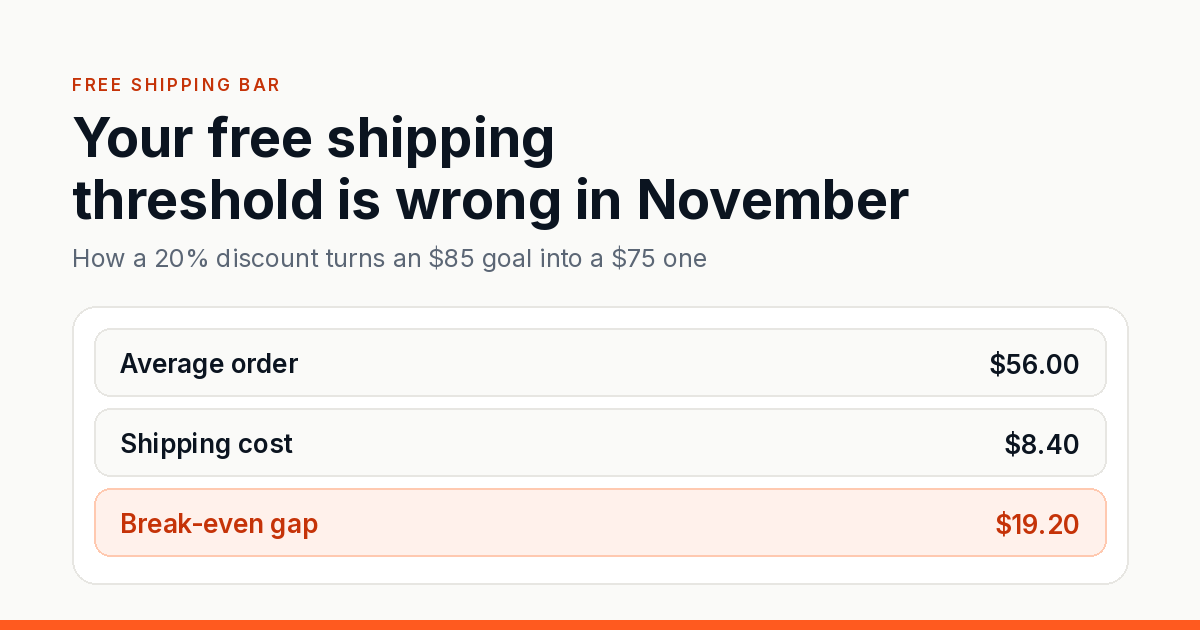
A free shipping threshold is a price you put on shipping, and BFCM moves all three of the numbers underneath it: the cart value, the margin rate, and the cost of the parcel. Most stores pick the threshold once in a quiet month, then run a sale that silently invalidates it. The bar keeps showing the same dollar gap while the order behind it is worth 20% less.
This is the arithmetic for setting a free shipping threshold that still makes sense in the last week of November, worked on round numbers so you can drop your own in.
The sale rewrites the number you set
Say your list-price average order is $70 and your threshold is $85. The bar asks the typical shopper to add $15, which is a realistic ask. Now run 20% off the catalogue and the same shopper's average order becomes $56. The threshold has not moved, so the gap is $29, roughly double what it was, and it appears at the moment traffic peaks.
The cost of that gap is not abstract. Baymard's cart abandonment research, excluding sessions where the shopper was only browsing, finds that 40% of abandonments cite extra costs such as shipping, tax and fees. A bar that promises free shipping and then shows an unreachable gap turns a reassurance into a reminder of the thing that was already costing you carts.
Shopify's own BFCM recap gives the scale of the weekend: $14.6 billion processed, up 27%, with an average cart of $114.70. That number is useful as context and useless as a target, because it describes thousands of stores selling different things at different prices. Your threshold has to come from your parcel, not from an industry average.
Three numbers make the threshold
Every defensible free shipping threshold is built from three inputs.
S, the landed cost of one shipment. Postage, packaging, and the labour to pick and pack it. If you ship a $38 order for $8.40 all in, S is $8.40. Do not use the rate you charge the customer, and do not use the rate the carrier quotes before packaging and fuel surcharges.
m, the contribution margin rate at the price you will actually charge. List-price margin is the wrong input for a sale week. If contribution margin is 55% at list, and COGS is 45% of list, then at 20% off the contribution rate falls to 43.75%. The formula is (0.80 minus 0.45) divided by 0.80.
p, the price of the cheapest add-on a shopper would actually want. This is the number most stores never write down, and it decides whether the bar works at all.
The rule that follows is short. Free shipping costs you S. To pay for it, the extra spend has to generate S of contribution margin, which at rate m requires S divided by m of additional spend. So:
Threshold = average order value + (S divided by m)
The arithmetic, worked
At list prices, with a $70 average order, $8.40 shipping cost and 55% contribution margin, the break-even gap is $8.40 divided by 0.55, which is $15.27. Add it to the average order and the threshold lands at $85.
Run the same store into a 20% BFCM sale and both inputs move at once:
| Input | September | 20% off |
|---|---|---|
| Average order | $70.00 | $56.00 |
| Contribution margin rate | 55.0% | 43.75% |
| Shipping cost | $8.40 | $8.40 |
| Break-even gap (S divided by m) | $15.27 | $19.20 |
| Defensible threshold | $85.27 | $75.20 |
The sale lowers the threshold you can defend and raises the break-even gap at the same time. That is the trap: a store that leaves $85 in place is asking for $29 against a break-even of $19.20, and a store that scales $85 down by the same 20% to $68 is asking for $12, so it absorbs shipping on carts that did not earn it back. The third option, and the only one that holds, is to re-price the threshold in discounted dollars.
| November strategy | Threshold | Gap to $56 | What it costs you |
|---|---|---|---|
| Leave September's number | $85 | $29 | No subsidy, but the bar reads as unreachable and the promise turns into a surprise at checkout |
| Scale it by the discount | $68 | $12 | You absorb $8.40 on carts contributing $12 against a $19.20 break-even |
| Re-price in discounted dollars | $75 | $19 | Break-even, and the gap is still closeable |
The gap has to be closeable by one item
A threshold above the average order only works if the gap can be closed by a single additional product. If the gap is $19 and your cheapest plausible add-on is $24, the shopper will add it and clear the bar. If the cheapest add-on is $9, they need three, and the bar becomes a request to build a bundle rather than a nudge.
That is a merchandising decision, not a settings decision. Two ways to fix it. Stock an add-on whose price sits inside the gap, which is what the frequently-bought-together suggestion in Free Shipping Upsell Bar is for, because it offers an item sized to the remaining gap rather than a generic cross-sell. Or raise the threshold until the gap matches a product you already sell at the right price. Lowering the threshold to make the number look reachable is the one move that costs margin without fixing the ask.
One threshold per market, or you are subsidising somebody
Shipping cost per order is not constant across the countries you sell into. A single threshold converted into six currencies overpays the subsidy in cheap domestic lanes and undercharges in expensive cross-border ones. The bar also has to display a number that reads as a real amount in the shopper's currency, or it looks like a currency conversion glitch on a product page.
Set a separate goal per market, in that market's local currency, and base each one on the landed cost in that lane rather than on a converted average. Free Shipping Upsell Bar supports per-country goals for exactly this reason.
Decide what counts toward the goal
Four categories should be excluded from the threshold calculation, or the bar will pay out on orders that were never going to ship anything:
- Gift cards and digital downloads, which have no parcel attached.
- Freight and oversized items, where S is a different order of magnitude.
- Pre-orders that ship in a separate window.
- Subscription first boxes, if the recurring shipment has its own rate.
Excluding them is a one-line setting. Leaving them in means a shopper can clear a free shipping threshold by buying a gift card, which is a discount on nothing.
The mobile constraint
Adobe's 2026 forecast expects a record 63% of Thanksgiving online spend to come through mobile, up from 61.6% a year earlier, against 57.4% for the season as a whole. Your bar will be read on a phone more often than not, at roughly 390 pixels wide, in the middle of a product page that is already busy.
Three rules follow. Keep the bar to one line of text plus a progress fill. Do not let it push add to cart below the fold. Update it once per cart change and leave it still, because a bar that animates on every scroll reads as an advertisement.
What fourteen days can and cannot tell you
Two weeks of sale traffic is enough to measure an average order effect and not enough to measure a conversion effect on a small catalogue. So judge the bar on two things: the share of carts that clear the threshold, and the AOV lift in dollars compared with the break-even gap.
If the lift is $11 against a break-even of $19.20, the bar is decoration and the threshold is too high. The analytics in the app report conversion rate, the effect on average order value, and a per-country breakdown, so the comparison can be made per market rather than on a blended number that hides one bad lane.
Freeze the number before 20 November
Testing should be finished by 6 November and the threshold, the add-on set and the placements locked by 20 November. After that you are changing a variable you cannot read, in the window where your support queue is least able to absorb a surprise. The BFCM discount math post has the calendar counted back from 27 November, and the same freeze date applies to this.
If you are also running tiers, check that the free shipping threshold and the quantity breaks ladder do not block each other at the cart, since a shopper who earns both should not have to choose. A gift with purchase is the cleaner lever when the discount has already eaten the margin that free shipping would have come out of.
The four numbers to write down
- S: landed cost of one shipment, including packaging and pick and pack.
- m: contribution margin rate at the prices you will charge during the sale.
- T: discounted average order value plus S divided by m.
- p: the cheapest add-on that fits inside the gap. If no such product exists, fix p before you touch T.
Run those four numbers the week you set the sale, not the week you launch it.
Frequently asked questions
What is a good free shipping threshold for Shopify?
Start from your own parcel, not an industry average. The formula is discounted average order value plus shipping cost divided by contribution margin rate. A store with a $70 average order, $8.40 shipping cost and 55% margin lands around $85 at list prices and around $75 once a 20% discount is applied.
Should I offer free shipping during Black Friday?
Only if you re-price the threshold in discounted dollars. Shipping cost does not fall when you cut prices, but the margin that pays for it does, so a threshold left unchanged asks for more from a smaller order. If the numbers do not work at sale prices, a gift with purchase costs less than giving away postage on every order.
Does a free shipping bar increase average order value?
It raises average order value when the gap can be closed by one item the shopper wants. When the gap is larger than any single add-on, the bar converts a reassurance into a reminder of the shipping cost, which is the reason Baymard finds in 40% of abandonments once browsing-only sessions are excluded. Measure the lift in dollars against the break-even gap, not against zero.
Can I set a different free shipping threshold per country?
You should, if you sell into more than one. Shipping cost per order varies by lane, so a single converted threshold overpays in cheap markets and undercharges in expensive ones. Per-country goals displayed in local currency keep the number honest in each market.
Still working out the number for your catalogue? Send us the parcel cost and the margin and we will run the arithmetic with you.